All resources
List of all resources.
Guidelines for Workers Applying Insecticides
CH056
***This resource is current to August 2010.
For information on the latest OHS requirements, visit OHS website.***
Discusses health risks, legislated exposure limits for workers applying insecticides and suggests controls.
PUBLISHED: August 2010
For information on the latest OHS requirements, visit OHS website.***
Discusses health risks, legislated exposure limits for workers applying insecticides and suggests controls.
PUBLISHED: August 2010
Use of Flammable Hydrocarbon Mixtures as CFC and HFC Substitutes in Vehicle Air-Conditioning Systems
CH058
***This resource is current to November 2010.
For information on the latest OHS requirements, visit OHS website.***
Lists the hazards associated with using hydrocarbons in vehicle air-conditioning systems and Environment Canada's recommendations if replacing refrigerants with hydrocarbons.
PUBLISHED: November 2010
For information on the latest OHS requirements, visit OHS website.***
Lists the hazards associated with using hydrocarbons in vehicle air-conditioning systems and Environment Canada's recommendations if replacing refrigerants with hydrocarbons.
PUBLISHED: November 2010
Silica at the work site
CH059
Introduces key properties and health effects of silica, and points to more information about legal requirements that will apply at work sites where silica may be present.
UPDATED: June 2026
UPDATED: June 2026
Reduced Sulphur Compounds: Focus on Thiols
CH060
***This resource is current to September 2002.
For information on the latest OHS requirements, visit OHS website.***
Discusses where thiols are found, associated health risks, exposure limits, suggested controls and emergency response.
PUBLISHED: September 2002
For information on the latest OHS requirements, visit OHS website.***
Discusses where thiols are found, associated health risks, exposure limits, suggested controls and emergency response.
PUBLISHED: September 2002
Use of Methyl Methacrylate-Containing Products for Fingernail Sculpting
CH062
***This resource is current to March 2010.
For information on the latest OHS requirements, visit OHS website.***
How to identify nail products containing methyl methacrylate (MMA), health risks and suggested alternatives.
PUBLISHED: March 2010
For information on the latest OHS requirements, visit OHS website.***
How to identify nail products containing methyl methacrylate (MMA), health risks and suggested alternatives.
PUBLISHED: March 2010

Coal dust at the work site
CH063
Introduces key properties and health and safety effects, and points to more information about legal requirements that will apply at work sites where coal dust may be present.
UPDATED: JUNE 2026
UPDATED: JUNE 2026
Styrene at the Work Site
CH064
***This resource is current to July 2009.
For information on the latest OHS requirements, visit OHS website.***
Discusses the properties and health effects of styrene, medical monitoring and preventative controls.
PUBLISHED: July 2009
For information on the latest OHS requirements, visit OHS website.***
Discusses the properties and health effects of styrene, medical monitoring and preventative controls.
PUBLISHED: July 2009
Hidden Danger: Hazardous Materials in Your Building
CH066
***This resource is current to November 2007.
For information on the latest OHS requirements, visit OHS website.***
Lists possible airborne hazardous materials and an employer's responsibilities to protect workers from exposure.
PUBLISHED: November 2007
For information on the latest OHS requirements, visit OHS website.***
Lists possible airborne hazardous materials and an employer's responsibilities to protect workers from exposure.
PUBLISHED: November 2007
Chlorine at the Work Site
CH067
***This resource is current to July 2010.
For information on the latest OHS requirements, visit OHS website.***
Lists properties of chlorine, health effects, protective controls and possible substitutes.
PUBLISHED: July 2010
For information on the latest OHS requirements, visit OHS website.***
Lists properties of chlorine, health effects, protective controls and possible substitutes.
PUBLISHED: July 2010
Perchloroethylene at the Work Site
CH069
***This resource is current to August 2010.
For information on the latest OHS requirements, visit OHS website.***
Lists properties and health effects of perchloroethylene. Discusses medical monitoring, protective controls, and possible substitutes.
PUBLISHED: August 2010
For information on the latest OHS requirements, visit OHS website.***
Lists properties and health effects of perchloroethylene. Discusses medical monitoring, protective controls, and possible substitutes.
PUBLISHED: August 2010
Lead at the work site
CH071
Introduces key properties, usages and health effects, and points to more information about legal requirements that support healthy and safe use of lead at your work site.
UPDATED: June 2026
UPDATED: June 2026
Cytotoxic Drug Exposure
CH074
***This resource is current to July 2017.
For information on the latest OHS requirements, visit OHS website.***
Information on the health risk of cyotoxic drug exposure to healthy human cells and suggested protective controls.
PUBLISHED: July 2017
For information on the latest OHS requirements, visit OHS website.***
Information on the health risk of cyotoxic drug exposure to healthy human cells and suggested protective controls.
PUBLISHED: July 2017
Protection of workers during remediation of illegal fentanyl labs
CH075
***This resource is current to August 2017.
For information on the latest OHS requirements, visit OHS website.***
Information on the hazards associated with fentanyl remediation, health effects, safe entry and recommended protective controls.
PUBLISHED: August 2017
For information on the latest OHS requirements, visit OHS website.***
Information on the hazards associated with fentanyl remediation, health effects, safe entry and recommended protective controls.
PUBLISHED: August 2017
Protection of workers from synthetic opioid exposure
CH075-1
***This resource is current to May 2018.
For information on the latest OHS requirements, visit OHS website.***
An in-depth review of hazard control for workers who may be exposed to opioids, addresses job-specific personal protective equipment and decontamination.
PUBLISHED: May 2018
For information on the latest OHS requirements, visit OHS website.***
An in-depth review of hazard control for workers who may be exposed to opioids, addresses job-specific personal protective equipment and decontamination.
PUBLISHED: May 2018
Naloxone in the workplace
CH076
Introduces - in general terms - OHS legal requirements that will apply if employers choose to authorize naloxone administration as part of an opioid overdose emergency response. Provides related links, including to Government of Alberta requirements.
UPDATED: March 2025
UPDATED: March 2025
Positive stop or limiting devices and multiple-overhead-crane lifts
CRA001
Explains the OHS Code requirement that an overhead crane operating on rails, tracks or trolleys be equipped with a positive stop or limiting device, or that the stop or limiting device be attached to the rails, tracks or trolleys.
UPDATED: July 2022
UPDATED: July 2022
Working in restricted or confined spaces
CS001
This resource provides information about Alberta's legislated requirements for working in restricted and confined spaces.
UPDATED: April 2025
UPDATED: April 2025
Anti-Fatigue Matting
ERG005
***This resource is current to August 2010.
For information on the latest OHS requirements, visit OHS website.***
Describes how anti-fatigue matting works and factors to consider when purchasing.
PUBLISHED: August 2010
For information on the latest OHS requirements, visit OHS website.***
Describes how anti-fatigue matting works and factors to consider when purchasing.
PUBLISHED: August 2010
How much can I lift?
ERG013
***This resource is current to February 2017.
For information on the latest OHS requirements, visit OHS website.***
Discusses the hazards of manual lifting, health effects and suggested controls.
PUBLISHED: February 2017
For information on the latest OHS requirements, visit OHS website.***
Discusses the hazards of manual lifting, health effects and suggested controls.
PUBLISHED: February 2017
Sitting and Preventing Back Pain
ERG014
***This resource is current to August 2010.
For information on the latest OHS requirements, visit OHS website.***
Suggestions to help reduce back pain for those who spend long hours in a seated position.
PUBLISHED: August 2010
For information on the latest OHS requirements, visit OHS website.***
Suggestions to help reduce back pain for those who spend long hours in a seated position.
PUBLISHED: August 2010
Fatigue, Extended Work Hours and Workplace Safety
ERG015
***This resource is current to February 2017.
For information on the latest OHS requirements, visit OHS website.***
Discusses the hazards of fatigue and extended work hours, health effects and suggested controls.
PUBLISHED: February 2017
For information on the latest OHS requirements, visit OHS website.***
Discusses the hazards of fatigue and extended work hours, health effects and suggested controls.
PUBLISHED: February 2017
Proper Height of Work Surfaces
ERG016
***This resource is current to March 2004.
For information on the latest OHS requirements, visit OHS website.***
Tips on how to adjust work surfaces to the appropriate height to avoid overuse or stress injuries.
PUBLISHED: March 2004
For information on the latest OHS requirements, visit OHS website.***
Tips on how to adjust work surfaces to the appropriate height to avoid overuse or stress injuries.
PUBLISHED: March 2004
Selecting Hand Tools
ERG023
***This resource is current to September 2010.
For information on the latest OHS requirements, visit OHS website.***
Explains the causes of contact stress, health risks and suggested controls.
PUBLISHED: September 2010
For information on the latest OHS requirements, visit OHS website.***
Explains the causes of contact stress, health risks and suggested controls.
PUBLISHED: September 2010
Ergonomics in the workplace: Vibration
ERG026
This resource provides information about the hazards associated with hand/arm and whole body vibration, OHS requirements related to workplace vibration, and best-practice controls.
UPDATED: February 2024
UPDATED: February 2024
Good Product Design: Avoiding the Average
ERG030
***This resource is current to May 2003.
For information on the latest OHS requirements, visit OHS website.***
How designers design for the average person, which doesn't always work.
PUBLISHED: May 2003
For information on the latest OHS requirements, visit OHS website.***
How designers design for the average person, which doesn't always work.
PUBLISHED: May 2003
Push It or Pull It?
ERG033
***This resource is current to August 2004.
For information on the latest OHS requirements, visit OHS website.***
Addresses safety concerns associated with wheeled equipment, such as carts, and suggests preventative controls.
PUBLISHED: August 2004
For information on the latest OHS requirements, visit OHS website.***
Addresses safety concerns associated with wheeled equipment, such as carts, and suggests preventative controls.
PUBLISHED: August 2004
Determining the Size of an Access Opening
ERG037
***This resource is current to October 20078.
For information on the latest OHS requirements, visit OHS website.***
Considerations when determining the size of an access opening.
PUBLISHED: October 2007
For information on the latest OHS requirements, visit OHS website.***
Considerations when determining the size of an access opening.
PUBLISHED: October 2007
Workplace first aid approvals
FA017
This bulletin explains how training agencies can apply for approval to teach workplace first aid in Alberta.
UPDATED: August 2023
UPDATED: August 2023
Managing Hot Work
FEX001
***This resource is current to May 2007.
For information on the current OHS requirements, visit OHS website.***
A description of hot work as a fire and explosion hazard and direction for performing hot work under the OHS Code.
PUBLISHED: May 2007
For information on the current OHS requirements, visit OHS website.***
A description of hot work as a fire and explosion hazard and direction for performing hot work under the OHS Code.
PUBLISHED: May 2007
Handling and Storage of Flammable Materials at the Work Site
FEX002
***This resource is current to July 2009.
For information on the latest OHS requirements, visit OHS website.***
A complete resource on flammable materials including definitions, associated hazards, worker training, storage, and incompatible substances.
PUBLISHED: July 2009
For information on the latest OHS requirements, visit OHS website.***
A complete resource on flammable materials including definitions, associated hazards, worker training, storage, and incompatible substances.
PUBLISHED: July 2009
Controlling the Explosion Hazard in Vessels, Tanks and Piping Systems
FEX004
***This resource is current to August 2010.
For information on the latest OHS requirements, visit OHS website.***
Outlines safe work procedures for preparing hydrocarbon-containing vessels, tanks or piping systems for hot work, confined space entry or hydrocarbon removal.
PUBLISHED: August 2010
For information on the latest OHS requirements, visit OHS website.***
Outlines safe work procedures for preparing hydrocarbon-containing vessels, tanks or piping systems for hot work, confined space entry or hydrocarbon removal.
PUBLISHED: August 2010
Working in smoky environments
FI008
This bulletin discusses smoky environments and wildfire smoke as a workplace hazard and provides health and safety information regarding potential health effects, risks and controls.
UPDATED: April 2026
UPDATED: April 2026
West Nile Virus and Workers
GH013
***This resource is current to August 2009.
For information on the latest OHS requirements, visit OHS website.***
Explains what West Nile Virus is and how it affects the workplace, suggestions for hazard assessment and controls.
UPDATED: August 2009
For information on the latest OHS requirements, visit OHS website.***
Explains what West Nile Virus is and how it affects the workplace, suggestions for hazard assessment and controls.
UPDATED: August 2009
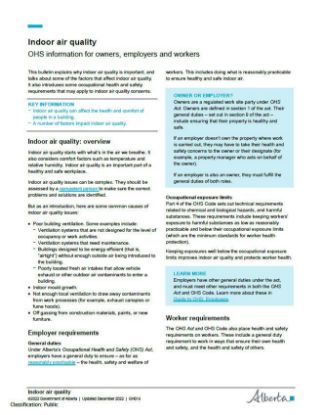
Indoor air quality
GH014
This bulletin explains why indoor air quality is important, and talks about some of the factors that affect indoor air quality. It also introduces some occupational health and safety requirements that may apply to indoor air quality concerns.
UPDATED: December 2022
UPDATED: December 2022
Indoor Air Quality Tool Kit
GH015
***This resource is current to August 2009.
For information on the latest OHS requirements, visit OHS website.***
A tool kit to help identify typical indoor air quality issues and suggest solutions to common problems.
PUBLISHED: August 2009
For information on the latest OHS requirements, visit OHS website.***
A tool kit to help identify typical indoor air quality issues and suggest solutions to common problems.
PUBLISHED: August 2009
Engineered Nanomaterials at the Work Site
GH019
***This resource is current to October 2014.
For information on the latest OHS requirements, visit OHS website.***
Discusses health effects associated with nanomaterials, legislation, hazard assessment and suggested controls.
PUBLISHED: October 2014
For information on the latest OHS requirements, visit OHS website.***
Discusses health effects associated with nanomaterials, legislation, hazard assessment and suggested controls.
PUBLISHED: October 2014
Securing Pipe and Other Cargo on Vehicles
GS001
***This resource is current to October 2009.
For information on the current OHS requirements, visit OHS website.***
Information about securing pipe and other cargo, including employer and worker responsibilities, and recommended practices.
PUBLISHED: October 2009
For information on the current OHS requirements, visit OHS website.***
Information about securing pipe and other cargo, including employer and worker responsibilities, and recommended practices.
PUBLISHED: October 2009
Servicing Tires Safely
GS003
***This resource is current to August 2004.
For information on the latest OHS requirements, visit OHS website.***
Addresses tire servicing safety requirements under the OHS Code including worker competency, split-rim or locking ring wheel assemblies and large vehicle assemblies.
PUBLISHED: August 2004
For information on the latest OHS requirements, visit OHS website.***
Addresses tire servicing safety requirements under the OHS Code including worker competency, split-rim or locking ring wheel assemblies and large vehicle assemblies.
PUBLISHED: August 2004
Guarding of Commercial Dough and Food Preparation Mixers
GS004
***This resource is current to March 2005.
For information on the latest OHS requirements, visit OHS website.***
Addresses guarding of commercial dough and food preparation mixers to protect workers.
PUBLISHED: March 2005
For information on the latest OHS requirements, visit OHS website.***
Addresses guarding of commercial dough and food preparation mixers to protect workers.
PUBLISHED: March 2005
Best Practice: Working Safely in the Heat and Cold
GS006
***This resource is current to July 2014.
For information on the latest OHS requirements, visit OHS website.***
Explains the health risks associated with working in extreme heat and cold situations and suggested controls.
PUBLISHED: July 2014
For information on the latest OHS requirements, visit OHS website.***
Explains the health risks associated with working in extreme heat and cold situations and suggested controls.
PUBLISHED: July 2014
Manually Energizing Power Systems after an Unplanned Outage: An Alberta Electric Utility Best Practice
GS008
***This resource is current to October 2010.
For information on the current OHS requirements, visit OHS website.***
Lists the standard minimum steps an electric utility must include for manually energizing a power system after an unplanned outage.
UPDATED: October 2010
For information on the current OHS requirements, visit OHS website.***
Lists the standard minimum steps an electric utility must include for manually energizing a power system after an unplanned outage.
UPDATED: October 2010
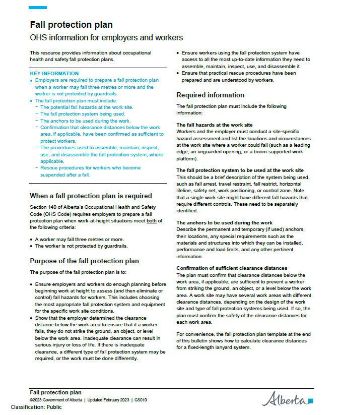
Fall protection plan
GS010
This resource provides information about occupational health and safety fall protection plans and their legal requirements.
UPDATED: February 2023
UPDATED: February 2023
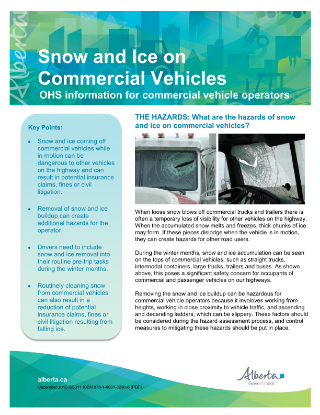
Snow and Ice on Commercial Vehicles
GS011
***This resource is current to December 2016.
For information on the latest OHS requirements, visit OHS website.***
Addresses the danger of snow and ice coming off commercial vehicles while in motion and the hazards associated with clearing snow and ice buildup.
PUBLISHED: December 2016
For information on the latest OHS requirements, visit OHS website.***
Addresses the danger of snow and ice coming off commercial vehicles while in motion and the hazards associated with clearing snow and ice buildup.
PUBLISHED: December 2016
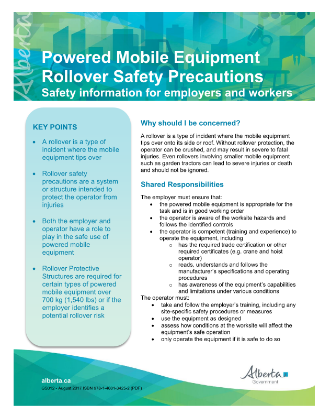
Powered Mobile Equipment Rollover Safety Precautions
GS012
***This resource is current to August 2017.
For information on the latest OHS requirements, visit OHS website.***
Lists factors that contribute to mobile equipment rollover and recommended safety precautions.
PUBLISHED: August 2017
For information on the latest OHS requirements, visit OHS website.***
Lists factors that contribute to mobile equipment rollover and recommended safety precautions.
PUBLISHED: August 2017

Domestic workers
LI069
***This resource is current to April 2022.
For information on the latest OHS requirements, visit OHS website.***
Addresses some of the hazards associated with domestic work and the obligations of employers and workers under Alberta OHS legislation.
UPDATED: April 2022
For information on the latest OHS requirements, visit OHS website.***
Addresses some of the hazards associated with domestic work and the obligations of employers and workers under Alberta OHS legislation.
UPDATED: April 2022
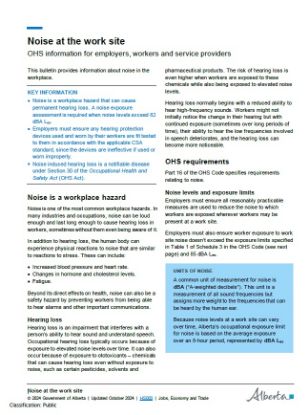
Noise at the work site
HS003
Discusses noise as a common workplace hazard, including information about associated health effects and exposure limits, implementing a noise management program, audiometric testing, and educating workers.
UPDATED: October 2024
UPDATED: October 2024
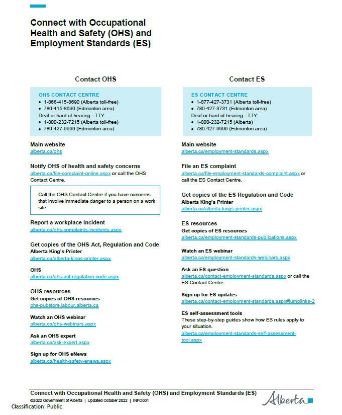
Connect with Occupational Health and Safety (OHS) and Employment Standards (ES)
INFO001
Contact information for Occupational Health and Safety and Employment Standards.
UPDATED: October 2022
UPDATED: October 2022
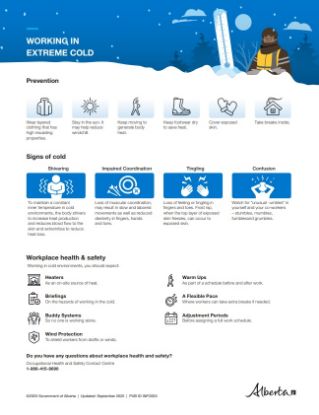
Working in extreme cold
INFO003
Infographic on the health risks associated with working in the cold, what to watch for, and how to prevent cold stress.
UPDATED: September 2025
UPDATED: September 2025
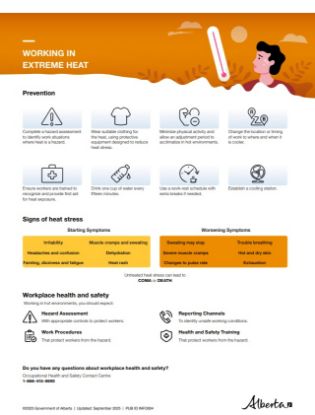
Working in extreme heat
INFO004
Infographic on the health risks associated with working in the heat, what to watch for, and how to prevent heat stress.
UPDATED: September 2025
UPDATED: September 2025
Prevention Initiative for Alberta's Occupational Health and Safety System
INFO005
Outlines the Prevention Initiative for Alberta's OHS system and discusses current priorities, guiding principles and current state.
PUBLISHED: March 2019
PUBLISHED: March 2019